
Chapter five

Life and Friends in the Country
There were several times in my life when I sensed that my life had changed and would not be the same again. This was one of them. I was now exposed to the country, with farmers and horses and fields of vegetables and fruit trees along the side of the lanes. In Hamilton, there had been my mother, my father and I. There was a nanny or housekeeper too, but I really don’t remember her. Now there was my Aunt Christine, my Uncle Eric, and also a new housekeeper, Theresa. From time to time, Theresa would bring one of her daughters from Hamilton to help her out. But I soon came to accept it as normal, and was surprised when my friends didn’t have all kinds of relatives in the same house.
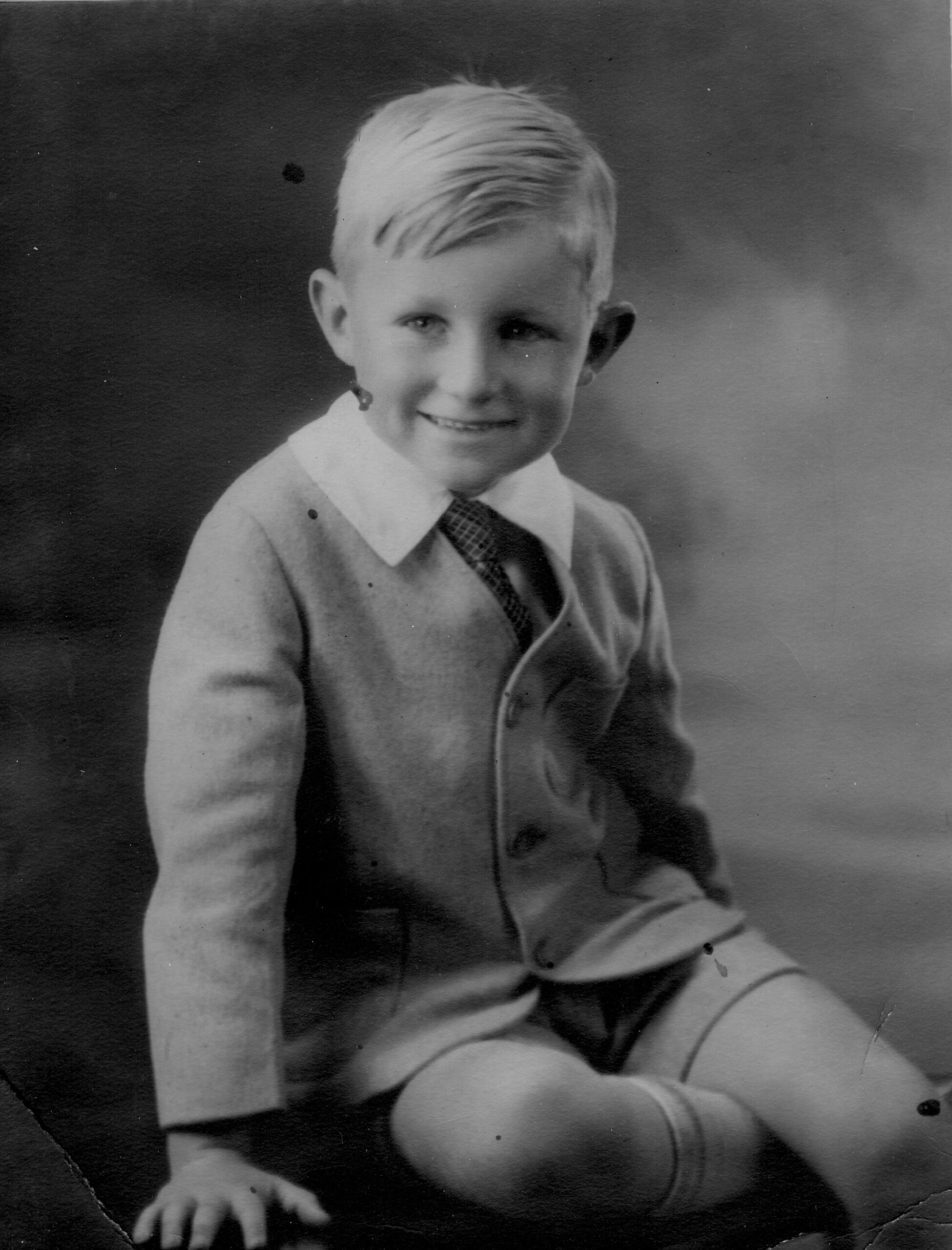
And I remember saying that I had three mothers, my real mother, Aunt Christine and Theresa our Irish housekeeper, and everyone laughing, because it was true. I mostly wore old clothes around the farm, but one time, my mother bought me a yellow suit – for ‘good.’ The shorts had buttons to button onto the top part to hold the pants up and keep it together. I wasn’t very good at buttons, so I had to get help when I went to the bathroom. My mother just loved the suit but it was a pain to get out of and into, and I got to hate it. I never liked yellow much after that.
I remember climbing the spruce trees on the front lawn until my Aunt Christine would tell my mother that I was going to break my neck. I remember climbing the old barn roof, and I got up to the ridge pole and was afraid to come back down because the old cedar shakes were pulling out and I was losing my grip. Theresa and my Uncle Eric had to rescue me. She climbed on the roof while Eric stood on the top of the ladder holding her feet. She said afterwards:
Glory be to God, he was roaring like Barney’s bull. And me afraid o’ heights. When I tried to pull him down, he kicked shingles at me. If the good Lord had wanted me, he’d ‘a taken me then.
I remember the old stable on the side of the barn. Mother said she was getting a riding horse but never did. I remember Mr. Atkins, the farmer next door used to bring his big horse and plough over in the spring to plough our acre or two and I would follow behind in the furrows, pretending that I was ploughing. My dad took movies of that on his 16 mm cine camera.
Out of the City, into the Country
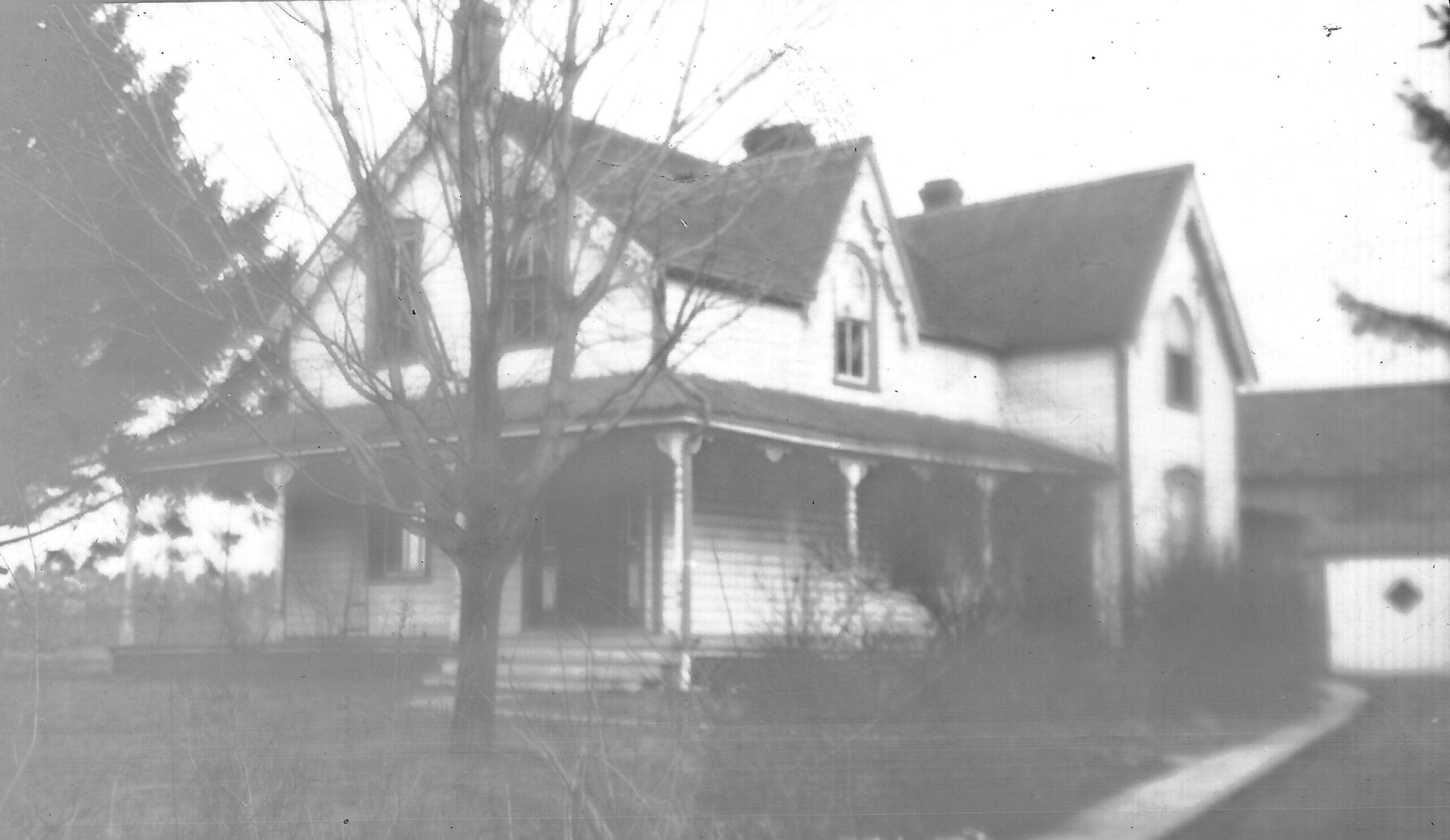
The property my father had bought was almost three acres. It was cut off from the rest of Mr. Bell’s farm to provide a retirement home for his parents. The old farmhouse was built in 1864 and may very well have been the original house on the Bell property. It faced north-west onto Plains Road which was the main road east from Hamilton and was also the first concession in Nelson Township.
Because it was based on the lakeshore, Halton County was on an angle to the coordinates, running from south-east to north-west. However for convenience I will refer to it as north and south. The base line of Nelson Twp. was called ‘New Street’ in Burlington although it certainly wasn’t ‘new’ and had been called that as long as anyone could remember. From there down to the shore of Lake Ontario was the ‘broken front’.
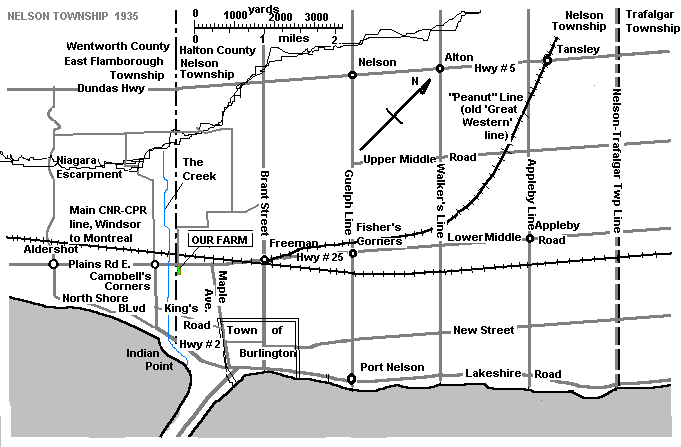
About half of the old Town of Burlington which I remember as a child was south of the first line and was thus in the broken front. In 1935 the town of Burlington had a population of about 3200. Today, the City of Burlington has a population of more than 200,000 and takes up all of what was Nelson Township in those days plus the most south-eastern part of the Township of East Flamborough, which lies adjacent to the west.
Our post office was in the hamlet of Aldershot, which was located in East Flamborough. But when I lived there, East Flamborough was part of Wentworth County, and Nelson Township, where we lived, was in Halton County. I never understood why our post office was in a different county from our house. But the school system followed county lines so it meant that I went to a one-room country school in Nelson Township, and my friends next door to the west of us went to the new, bigger, Maplehurst School on West Plains Road in East Flamborough Township. It was all very confusing for a young boy.
The post office in the town of Burlington was right downtown and as I recall, served only the town itself. Just inside the door there was a large wall of boxes for local mail. I’m not even sure if they had door-to-door delivery in those days. The rural routes were delivered from three surrounding post offices, Aldershot to the west, Freeman to the north and Port Nelson to the east. We were better off than the people in town who had to go to the post office for their mail. We had a big mailbox beside the highway, and every morning, the mailman would drive around in his car and stuff mail in the box. I remember Aunt Christine watching for him.
Maple Ave. was the western boundary of Burlington, but it ran on an angle and didn’t follow the surveyed lines. The town went just beyond Caroline Street to the north, and on the eastern boundary, to the place where New Street curved around to line up with James Street in the town. Brant Street was the main north-south street of the town of Burlington and also the first north-south concession line in Nelson Township.
Concessions
It may be necessary to explain to those who were not raised in the country about concessions. In the 1790s the Governor, John Graves Simcoe decided to survey the settled part of Upper Canada. It was first divided into townships and later groups of townships were formed into counties. Since all the land belonged to the Crown, the survey divided all the townships into blocks of 1000 acres. Some townships had rectangular concessions, but if they were square they were a mile and a quarter to a side. A road allowance of one (surveyors) chain (66 feet) was included on all sides, including shorelines and township or county lines.
Roads were built in most of them, called concession roads or lines. They were numbered from the south and west, or in the case of Nelson Township, which had been surveyed in a decidedly northwest-southeast direction, from the side which was closest to the south or west. Also, in Nelson Township the blocks were not square, but more of a parallelogram.
The convention grew up to call the east-west lines ‘concessions’ or ‘roads’ and the north-south lines ‘lines’. The only exception was the Base Line, which ran east-west. It would be the zero concession, but no number was assigned; it was not counted. Hence, in Nelson Township, the base line was ‘New Street’; the first concession was ‘Plains Road’ in Burlington but was known as the ‘Lower-Middle Road’ further east.
The second concession was the ‘Upper-Middle Road’; the third concession was ‘Dundas Road’ or ‘The Dundas Highway’, which was Highway #5, and so forth.
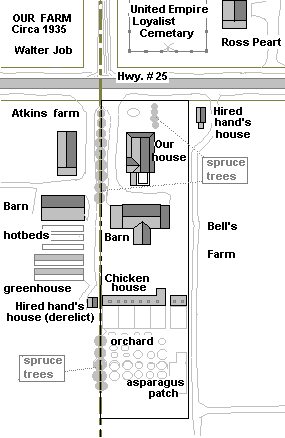
The north-south ‘Lines’ were the Wentworth-Halton County Line which ran beside our house and was not numbered. There was no road, but technically, our whole driveway and the corner of the barn lay in the 66 foot road allowance, which had been deeded to the Bell property. North of us there was a small gravel road which followed the county line as far as the edge of the escarpment, but then turned east. The first line was Brant Line, Brant Street in Burlington, the second was called ‘Guelph Line’, the third, ‘Walker’s Line, the fourth, “Appleby Line” and so forth.
The old Farmhouse
The property faced onto East Plains Road, which was called the Lower Middle Road in Nelson Township. It had been part of the old Bell homestead. The Bells now lived in a newer house over on Maple Avenue. The Bells’ original farm was probably a full lot of 100 acres, or maybe two lots in the first concession, with Plains Road to the north, Maple Avenue on the east, and the county line, between Halton and Wentworth counties, to the west. Maple Avenue was probably put through later and Plains Road was one of the original surveyed lines. It made sense to have the old farmhouse on a main road.
It had an old barn which seemed to be older than the house. The frame was adze-squared timbers, about 8 or 9 inches square. They were put together with mortises and tenions and the joints secured with wooden pegs. The rafters were pine saplings, flattened only on one side, with the bark still on them. Hand forged square nails were used to attach the siding and the roof boards. It was clearly built by the local farmers who used what they had.
The central section was fairly small, as barns go. It was probably about 25’x40’. But there was a large workshop lean-to on the west end and a smaller stable on the east end. There was a large two story wing extending out behind, which was almost as big as the original barn. Clearly it had been used as a haymow, because there was a large chute down to the stable.
It was somewhat dilapidated, and there was a two foot drop from the second level in the main part to second level in the back wing. There was also a walkway about three feet wide at second story level across the back of the workshop lean-to. It led to a steep staircase (more like a ladder) down to the ground level at the far end. There was no railing and it was exciting to walk across with a chasm on one side, rough planking on the other and pine pole rafters above. I explored this whole area. It is a wonder that I survived this period with only a few scrapes and bruises.
About 100 feet behind the barn was the chicken house. It was a long low building which ran the full width of the property. Actually it was two buildings, because closer to the east end, the two parts were separated by a passage way which was a continuation of the path from the house and barn to the orchard beyond the chicken house. The building consisted of five sections, each of them with roosts and nests for the chickens to lay eggs. The south wall was large windows looking out on chicken runs.
When my cousins George and Harry were raising chickens and selling eggs, all five sections were used for chickens. At one point they had over 500 laying hens. I remember Harry talking about Leghorns, Rhode Island Reds and Barred Rocks. We also had Mallard ducks and a couple of geese in one of the runs. After Harry had given up the chicken farm idea and went to work in the Dominion Foundries and Steel plant in Hamilton, my Uncle Eric kept about 20 or 30 chickens in two sections, for eggs and chicken dinners for the family. The other three sections gradually filled up with old furniture and family junk. Exploring it was lots of fun.
Life on the Farm
In the early years, I remember climbing trees and running around the barn and the chicken house. I remember Nipper, our spaniel who must have died when I was quite young. Cousin Harry had a dog too, a border collie who was killed on the highway. We had a cat ‘Tillie the Toiler’ named after a popular comic strip character of the times. It was an idyllic time of lazy summers and winters which had snow but never enough. I remember tasting snowflakes on my tongue, and making snow angels on the front lawn. In a good winter, a big snowdrift would form beside the chicken house, and I would dig a snow fort right into the drift. One year I had rooms and a lookout post which I could crawl into. But over the next few years the drifts seemed to be getting smaller and smaller. Perhaps I didn’t realize that I was getting bigger too.
And sometimes my cousin Jane and Aunt Madeline would come out for Sunday tea. And Peter and Alice Jane Kappele came out with ‘Aunt’ Reba and ‘Uncle’ Dan. That was even more fun because we got into all kinds of things, such as chasing the chickens or giving each other rides in the wheelbarrow. There were very few children my own age in the neighbourhood. Murray Peart across the highway was a year and a half older, which is quite a lot when you are five. John Lindley was half a mile away across two busy roads. But I was having such a good time that I didn’t realize this until some friends my own age came to visit.
I grew up in a world of adults, and mostly female adults at that. As I have said, I had three mothers, my real mother, Theresa and Aunt Christine. My Uncle Eric seemed to be always working on the farm or sitting in his room listening to his old fashioned radio. Sometimes I sneaked in beside him to listen to “The Happy Gang” with Bert Pearl. My father was in at the ‘Lab’ or off on some professional business which I didn’t always understand. So I had some problems when I got with other kids in groups. They were always teasing and kidding around. Sometimes they got mad and had some really vicious fights. I didn’t know how to deal with that and withdrew. Sometimes they seemed to come after me but I wouldn’t fight and they gave up.
I got teased a lot too. This was partly because of my shyness, but also because of my last name. You wouldn’t believe some of the insulting nicknames I got. And when I fought back, the kids got really mad. Apparently it was OK for them to tease me, but not for me to tease them. Sometimes I ran to other adults but they weren’t very sympathetic. They seemed to think that I should fight my own battles. So when I was very young, I was just as happy to stay with the adults. I learned a lot of games and activities which I could do by myself. I was really good with plasticine, and building blocks fascinated me. The great mud pile beside the barn could keep me occupied for hours all summer.
Port Dover
We described the earliest recollections in Chapter Three so I recall many happy times there as I grew older. While my grandmother was alive, we were there every summer. By this time, I was learning to swim, but the lake was so shallow that you had to wade out a long way before it was deep enough to swim. We also went into town to band concerts in the Park and toured around the area. I remember that there was a small lake called Silver Lake just to the north of downtown. It was quite clear, unlike Lake Erie that always looked cloudy and often had algae blooms in hot weather. And every summer, around the first of July, the shad flies would mate and soon after, die which made the streets greasy and cars had trouble making it up the hill on the main street.
Port Dover was a fishing port. Every morning the fishing boats would head out into the lake and their catch would be sold at the little shop at the foot of the pier. There were lake trout, bass and sometimes other fish for sale. My father loved fresh fish so we would have it regularly and on the way home he would buy more so that we could have fish dinners at home.
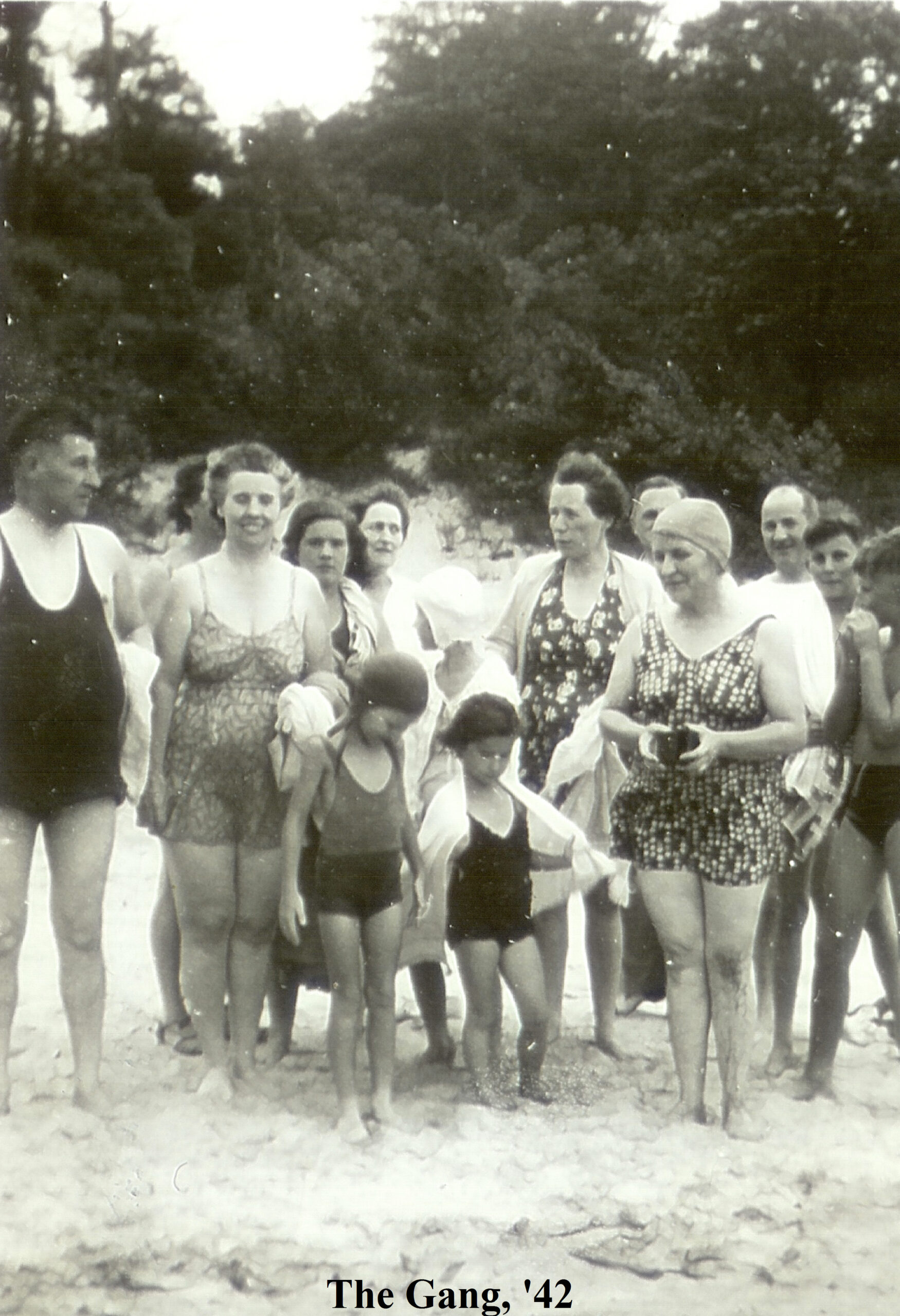
Grandmother died in June, 1940, just after the start of the War. I remember going in to the visitation at the old house on Blake Street. She was laid out in her coffin at the front of the living room. As I stood looking at her, she looked waxen and pale but almost life-like. I asked my mother if I could touch her. She said “yes, John” and I reached over and touched her cheek. It was my first encounter with death and it left a lasting impression.
When the estate was settled, Aunt Madeline got the house on Blake Street and we got the cottage. My father was not too pleased with this because the house was much more valuable and he thought that it should have been divided more equally. But mother said that she could imagine the thinking behind this decision. Grandmother thought that mother was married to a rich doctor whereas Aunt Madeline was married to Uncle Cecil who had a precarious job and little money. It seemed to make sense to me.
Then, when the War started, Uncle ‘Ces joined the Army and went overseas in 1940. I was jealous of my cousin Jane because she had her own suite in the former servants’ quarters on the third floor and my bedroom was right next to my parents’ bedroom so they could hear everything I did. But life went on.
Winter
Winter in the country was different from winter in the city. In the city, the fresh snow soon changed from pristine white to dirty grey piles melting beside the street. In the days before road salt, the ploughs never got it all up, so in colder climates, the ice would build up on the road surface and whenever it thawed, the ice would break up leaving large ice potholes which could break a car spring, or loose chunks which could jam under your car and rip out the muffler. In cities farther north, this would only happen once a year – at spring break-up when the ice on the roads could be up to a foot thick. In Hamilton, it was seldom that cold so there were several ice break-ups a year, with slush like gruel to churn through.
That is why many people put their cars up on blocks for the winter. My dad was a doctor, so he needed his car all year round. By the mid-1930s, when I became interested in cars, more and more people were keeping their cars going through the winter. I can remember trying to shovel the snow out of the driveway so that my dad could get in to the garage. Uncle Eric usually did most of it. Cars used chains to get some grip on the ice, but the car could not be driven very fast. Dad often broke a chain and would come limping up the driveway with the broken end hitting the fender on every turn of the wheel. Chains were the very devil to put on and take off, so dad would go without and often got stuck in deep snow.
The Steel Company and the Dominion Foundries in Hamilton had large coke ovens so many people in Hamilton burned coke in their furnaces. The ashes were collected with the garbage and were used on the street when the ice built up to give the car tires some traction. Because we lived in the country without garbage collection, and we burned anthracite coal in the furnace we got clinkers which were big chunks of ash fused together. My uncle would break them up with a hammer so that we could use them on the driveway. I have an old movie which shows me riding in an ash bucket on a sled pulled by my uncle.
My mother got me a ‘Flexible Flyer’ one Christmas. These sleds had high narrow runners which could be steered by pulling a cross board on the front. They were fine in hard packed snow, but the snow on the farm was deep and soft so my sled bogged down all the time. The next year, I got skis which could be strapped onto my galoshes. This was better and I tramped around the whole two-and-a-half acres on them.
My first skates were funny little double runner things which strapped on my galoshes. There was often some water in Mr. Bell’s field which formed a rough and ready skating rink after we scraped off some of the snow. Theresa got a kitchen chair for me to push and hang on to as I took my first tentative steps on the new skates. I remember this for several winters. Then I got proper “tube” skates and skated around on my ankles for a winter or two. The big problem seemed to be getting the laces tight enough and I remember pulling on them and using a lace hook to try to get them tighter. It seemed like a lot of work to go skating.
Galoshes and heavy coats were the order of the day… and woollen mittens on a string so they would not be lost… and toques and knickers… and long-johns. I had the kind with a vertical slot opening in the back but some of my friends had the trapdoor type. Both kinds got caught on the toilet seat and sometimes we had to suffer the indignity of having some adult untangle us from the toilet or help us to get rebuttoned. I don’t know how we kids survived. But in spite of all this, I loved winter and hated to see it end.
Spring
One day we would notice that the days were longer and the sun was brighter. The snow was melting and forming puddles and muddy patches. The fields were often half full of water and attempts to cross them resulted in our galoshes being sucked off—even our socks sometimes. Some kids wore gum boots. These were short rubber boots which laced up the front. They were made in Acton by the Gutta Percha Rubber Company and Acton was in Halton County, but it was in Nasagewaya Township which was still a long way away from us. Gum boots seemed to stay on better than galoshes.
Sometimes I got so muddy on the way home that I was stripped down outside and all my clothes went into the laundry tub in the basement. Then I went right into the bathtub. Theresa sounded mad and she could never understand how I could get so dirty just walking home from school. But waking along the side of the road wasn’t any fun. Only girls and sissies tried to stay clean on the way home.
As the days got warmer, we would look forward to Queen Victoria’s Birthday. We sang the song about it:
Twenty-fourth of May …is the Queen’s birthday.
If we don’t get a holiday …we’ll all run away!
Uncle Eric would be getting the fields ready for planting. Mr. Atkins would bring in the horse and plough. I would help my uncle cut up the seed potatoes for planting – each piece had to have an eye on it or it wouldn’t sprout. The apple and peach trees would bud and then blossom. Blossom Sunday in mid-May was a big event in the Niagara Peninsula. We would pile in the car and join the long lines of slow moving cars through Stoney Creek, Fruitland, Grimsby, Beamsville, Vineland, Jordan, and St. Catherines.
Asparagus
The asparagus would start to break the ground and I would try to cut some before it was ready. At that point it was white and almost tasteless. We couldn’t wait until it was above the ground and we could have a good feed. By early June the stalks would be thick and luscious and we would enjoy them at dinner every night. But by July, the shoots were growing into long fronds with bushy branches that were higher than I was. All summer it was a great place to play and hide. No one could see you and when my friend Peter Kappele came to visit we would clear a small space and hide out there.
The Sunday drives would start. My father liked nothing better than piling us in the car and going for a drive on all the back roads. Then he would reminisce about how much better the roads were than they were when he was a boy. I always wanted to go somewhere – like Toronto, but dad was happy to just drive and to decide which way to go only when he reached the next corner. After a bit I came to enjoy this kind of outing. I remember going up to Flamborough Head and Rattlesnake Point. We went up and down the escarpment on hilly gravel roads.
I remember when they put the high-level bridges over the deep gullies on the Dundas Highway, at Sixteen Mile Creek and Bronte Creek. Before that, there was a funny road down the side of the gully, a wooden bridge over the creek and another steep road up the other side. One of the bridges seemed quite long to me. There were no sidewalks on these bridges so people on foot had to walk down the middle of the highway. Every fifty feet or so there was a little balcony sticking out on the side of the bridge for the walkers to stand while a wide car or truck went by. This was progress.
The long-johns were put away for the summer – none too soon for most boys. June was often hot and all the vegetables were up. The fresh lettuce was about the first to be picked but the fresh peas were amazing. I couldn’t believe that they were the same vegetable as the insipid canned peas which we had the rest of the year. And the chickens would start moulting. All the heavy winter feathers would fall out and new ones grow in. There were feathers everywhere and the chickens looked as if they had been hacked at with a pair of scissors. The days were now so long that I was going to bed in broad daylight. The sun was still up. Gradually the season changed into summer.
Summer
Until I started school, it seemed that spring just blended into summer. It was hot days and sometimes hot nights which kept me awake. House air conditioning was unheard of, although there were some air conditioned movie theatres who proudly announced on big signs: “IT’S COOL INSIDE”. I couldn’t understand why my aunt and my mother went around closing windows in the morning when I felt we should be opening them to catch the breeze. Then they would open them in the evening when it usually cooled off a bit. Years later Theresa explained that the house cooled off at night and if the windows were closed in the day it stayed cool longer through the day. But this window opening and closing ritual was just one of those big adult mysteries to me as a child.
Murray Peart would come across the road to play with me quite often. I have some old movies of us playing as Indians having a pow-wow on the front lawn. The lawn mower with an old sheet draped over it served as a wigwam. I also have some movies of a whole bunch of us playing on a monkey bar which my Uncle Eric had fixed between two spruce trees on the front lawn. We had an old lawn swing which we could get swinging so fast that it tipped over.
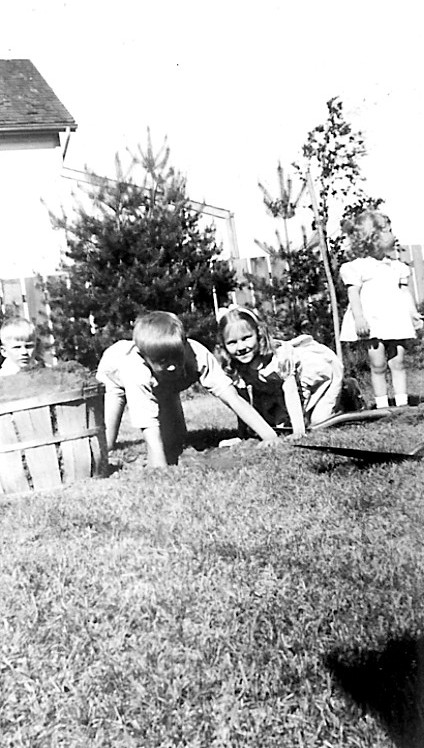
Once in a while, the Robertsons would come from Walkerton. David was a bit older, Margaret Ann was about my age and Ronald was a year younger. I had dug a swimming hole in the sand pile which had been excavated from the basement, and in hot weather it was used a lot and soon turned into a muddy hole. Ronald and I were cavorting in the muddy water when Margaret Ann came out, in her pinafore and frilly dress. Ronald said that I pushed her and I said that he pushed her. Anyhow she wound up falling into the mud hole. I remember her in tears, with Theresa turning the hose on her. We thought it was very funny, but I guess the adults didn’t. We were banned to the kitchen for supper.
I played with Theresa and Helen sometimes but they were five years younger and they were girls. But they were closer in age to my cousin Jane so when she come out with her parents for Sunday dinner or tea we played together. When it was very hot, Jane would look at me in the swimming hole and Aunt Madeline would say sternly: “Jane, you don’t want to play there, do you!” This was not a question but a command and I wondered at the time if Jane had any say in the matter. Soon Theresa would bustle around, drag me unceremoniously over to the house and turn the hose on me so I could be cleaned up for tea with the grown-ups.
I would explore the property and sometimes walk down Mr. Atkins’ lane to the creek. There was a place where there was a steep bank and a very small woodlot, but most of this was on the Bullock’s farm which fronted onto Highway 2 south of Campbell’s Corners, and I was not supposed to go any further than the creek. I went across into Bell’s field as well, but there wasn’t much interesting there. I was not allowed to explore north because I could not cross the highway on my own. I remember my Aunt Christine taking me for a walk up the township road beside the cemetery and Job’s farm. She had a hat and a walking stick with a silver band around it which I still have.
I would climb the big old spruce trees in front of the house. When I was small, I could not reach the bottom branch unless I dragged over one of the wicker lawn chairs to stand on. When I was a bit bigger I could grab the bottom branch and swing myself up onto it. As I tried to climb higher in the tree, I got into prickly branches and rough bark and I got covered with spruce gum. But over the years I could climb all the trees in the front yard. By this time the asparagus had grown up so that the tops formed a thick green mesh about three or four feet high. It was so dense that you could disappear into it and hide from everybody. Jane and I would play hide and seek there and no-one knew where we were.
I remember one time Theresa gave me a hard time about something and I said that I would run away. I wasn’t very happy when she offered to help me pack a bag. Another time I hid in the guest room closet and waited to see if anyone noticed that I was missing. Eventually they did notice and began calling – then searching. When they started sending Eric down to look in the creek, I was getting embarrassed that I had let it go that far, and so I came out, acting as if nothing had happened. I pretended that I didn’t even know that they had been looking for me. But it felt good to know that I was loved.
Sunday tea was a substitute for supper that day and we usually had it on the old wicker furniture on the front lawn. There were two armchairs, a settee and a large footstool, all with cushions. We also could use the lawn swing for seating if necessary. That wicker lawn furniture was great. It could be turned into a train or a bus or anything else which creative kids could design. Dad took movies of one of our creations on the front lawn. It seemed that it spent more time on its side arranged in a row or tilted against each other than it did for its intended purpose. We still have the last remaining chair of that set which is up at our cottage.
On a hot afternoon, we at least had some cooling breezes from the west. But when a passenger train came through, the engineer would lean on the steam whistle all the way from Aldershot, to Freeman because of all the level crossings. Conversation on the lawn would stop until the train had gone through. My Aunt Christine, who was stone deaf, was unaware of this and would go on talking although no one could hear her. She read people’s lips so well, that sometimes you were unaware that she was deaf. I realized that when she was talking and I could see her lips moving, but couldn’t hear her for the train whistle. I realized that was what it was like for her all the time.
By late July, the corn was getting ripe. I liked all the vegetables we grew on the farm except for parsnips and maybe turnips, but I loved corn. We liked Golden Bantam the best. The ears were smaller than some of the other types but were a lot sweeter. My uncle had patches planted at several times over the summer so that we could have corn anytime between late July and early October. I slathered it with butter and ate it ‘typewriter-style’ – often ignoring the rest of my dinner until my mother would say sternly: “John, eat the rest of your dinner or no dessert!” But I guess I was a good eater, because I never seemed to have trouble finishing my plate.
Autumn
As spring merged gradually into summer, summer merged gradually into fall. It could still be hot in September, but the nights were cooler and the days got shorter so that I no longer had to go to bed in broad daylight. I could no longer go outside in my old shorts and nothing else. Then the leaves on the trees began to get yellow or red, and after a while began to fall. My father would say: “I guess that fall is here”, and I thought that meant that he had just seen some leaves falling.
I remember one time, having dinner in the old dining room, before it was turned into the front hall. I knew that it was about the first of October, because my dad always opened the day’s mail at the dinner table and I saw the date on one of the letters. Theresa carried in a big plate of steaming corn and Uncle Eric said: “I figure that’ll be the last of the season”. Aunt Christine was talking at the same time, but we got used to that because she couldn’t hear.
I think that we all got into bad habits because if any of us wanted to get a word in edgeways, we just had to start talking. That was about the time that I realized that if she couldn’t see my lips or if I tried to speak without moving my lips, she didn’t know what I was saying. It was great. I remember my mother saying: “John, you shouldn’t say things like that in front of your aunt”. And my reply: “Aw mom, she can’t hear me anyway.
October and November were cold and cloudy – often wet. Then there was frost on the ground in the morning and after a time, it was happening almost every night. We would have some snow, but the first snow was usually just a few flakes and it didn’t last long. Then I would wake up one morning and the ground would be white and I would dream of a white Christmas. But even that snow didn’t seem to last. Then it would be my birthday and once in a while I could have a party with some of my friends. One year, my mother talked about having my birthday and Christmas together but she said that I raised such a fuss that she never mentioned it again. But that meant that autumn was over and winter was beginning again.
A Child’s Christmas in Aldershot 1
With apologies to Dylan Thomas.
Whenever I think of Christmas I remember little cotton-wool-covered cardboard houses with cracked cellophane windows, and father pleased with himself because he had found a butcher who drew his own turkeys the old-fashioned way. He took me into the dark and forbidding Liquor Control Board store on a dark and forbidding street to buy the Christmas wine and the man behind the counter would peer through the iron grating and say “I won’t arrest you this time, young man, because you’re with your father.” and I worried that someday he would.
My dad would buy a big tub of Imperial cheese and it would sit on the side table all through the Christmas season for people to snack on. I didn’t like cheese much but everyone else was digging in so I tried it too. It was OK with lots of crackers.
And we would choose up parts for the Christmas play at our one room country school and argue who would be Joseph, and Mary, and which end of the donkey. And the fathers would come in one day with boards and trestles and set up the stage right across the front of the classroom and move Miss Huffman’s desk right over in the corner. And on the day of the play, we were all excited as the parents had to squeeze around one end of the stage to get in and they looked funny in the little desks and we peeked through the curtains and loudly tried to guess which parents went with whom. And Miss Smale played the piano and some of us sang “While Shepherds Washed their Socks by Night” and Miss Huffman was mad because she couldn’t tell who did it.
And in the morning I’d get up and take my socks and underwear down to drape over the Esse Storage Cooker as I got dressed because they were too cold to put on and Theresa would shoo me out of her kitchen with the broom which hurt against my bare bum. And Aunt Christine made peanut butter cookies mashed down with a fork, and Theresa the house-keeper, let me lick out the bowl and Aunt Christine complained because she needed the bowl to make a new batch.
And Johnny Zweep said there wasn’t any Santa Claus and I told some younger kids, and Murray Peart who was older said I wasn’t s’posed to do that, and the younger kids cried, but they didn’t believe me anyway and I wasn’t sure that I believed it either. And we’d make angels in the snow and have snowball fights and Miss Huffman declared a no-snowball zone outside her window and all the girls and sissies like David stayed in there and we taunted David to come out of the doorway and Miss Huffman came out instead and got a snowball right on the bosumba and John Lindley got the strap.
And Elsie Atkins next door was my Sunday school teacher and one year when Christmas was on a Sunday, asked if I was going to church and I said “You don’t go to church on Christmas.” and my mother glared at me. And we always got a spruce tree and Mother and I put it up because every time Dad did it, it fell over, and the lights wouldn’t work and we couldn’t find the bad bulb. And I’d set up a Christmas village with the little cardboard houses in the big bay window in the dining room and one year we had a little play there with my cousins Jane, Carol and Ann who was only three, and at the end Ann bowed the wrong way and her mother was upset to see how dirty her panties were because we’d showed her how to slide down the coal chute.
The night before Christmas I hung one of Dad’s great big golf socks on the fireplace and left some sherry and a cookie for Santa because Dad said he got tired of milk. And Theresa said that Aunt Christine got into the sherry and that was the only time I saw her happy and mother said “John, your Aunt is not drunk, I won’t hear of it!” and Theresa winked at me and Dad said “What happened to all the Sherry – I just bought it?”
And on Christmas Eve I thought I heard Santa downstairs but it was only Mom and Dad going to bed. And sneaking down the stairs in the morning when it was so dark that I stumbled over the rug in the hall and after I had been there a while I heard the clock strike five, and having all my presents open before anyone else was up and when Mother acted as Santa Claus after breakfast and handed gifts to everyone, I didn’t get any and being mad at Santa.
And Madame McLay coming from Montreal every year to spend Christmas with us. She was a First World War Bride from Belgium, who had married a doctor friend of my father, and come with him to Canada after the war. He died before I was born and dad had sort of taken her under his wing. She must have been very cultured; dad said she was more French than the French. She was always criticizing my table manners, and my general upbringing, and sometimes I thought that I had four mothers, at least at Christmas. When I got older, I called her “Tante Jeanine” to her face but sometimes other things behind her back.
And having Christmas dinner in the dining room with all the family at the table, and having to put all the extra leaves in it for sixteen people, and mother almost slipping under the table trying to reach the foot bell with her foot to call Theresa. And Dad carving the turkey and telling how you draw a turkey the old fashioned way and Aunt Madeline feeling ill and Mother saying “Bill, really!”
And Mother served the mashed potatoes and turnip and I hated turnip and filled up on celery and carrot sticks and Theresa didn’t have any more. And I got served last because even though my cousins were younger, they were ‘guests’ and I protested and was sent to my room but my Mother let me out again as long as I apologized and I would spend a long time figuring out how to apologize without saying I was wrong.
And Tante Jeannine would say in that syrupy voice “Now we really are sorry, aren’t we, John!” and I knew I wasn’t sorry and I didn’t think she was so I didn’t know what she meant. She was not really my aunt but that’s what you called your parents’ friends, she was from Montreal and came every Christmas and she seemed even crabbier than Aunt Christine. I didn’t find out till I was all grown up that her husband, Jimmy McLay, had killed himself with carbon monoxide at Christmas time and then I knew why she was like that.
Sometimes the Kappeles would come out and Jane, Peter and I would put coal in the dog’s bed or scare Uncle Eric’s chickens so they wouldn’t lay. Uncle Dan Kappele would fill up on sweets in the kitchen and Aunt Reba would be mad because he was diabetic. And Theresa’s two girls would do the dishes and Peter and I would say “Nya! Nya! – boys don’t have to do dishes!” and they would throw soapy water at us or maybe the leftover turnip off my plate.
And Mother would play Christmas carols on the piano after dinner and we would all sing. They’d get Uncle Dan and Dad to sing “Frankie and Johnny were Lovers” but if they were feeling good, we weren’t allowed to hear all the words. And Aunt Madeline would invite us all to her place for New Year’s dinner and people would start to look at their watches and find their coats and Aunt Reba would tell Uncle Dan that she was driving which was funny because she never did other times.
And then the house was quiet and I had to go to bed and we’d all say “Merry Christmas” and kiss goodnight and Dad always had sloppy kisses but it didn’t matter, we felt warm and good. And then it was all over for another year.
Nursery School
These days were sometimes hard on a little guy but as I think back on them they had an idyllic quality. But the idyllic times were to end. When I was about five, my mother discovered that there was no kindergarten at the local one room school and also that I had to be six by December the first to get into grade one. Of course my birthday was later in December so it meant that I had to wait another year when I would be six years eight months. My mother had been reading to me and I was already reading some simple books and drawing and modeling in plasticine. She was not taking it well that I had to wait till I was over six when she thought that her son was ready for school at the age of five. So when she found out that there was a nursery school and kindergarten at Ann Peart’s home on the Guelph Line and that she had a son my age named Peter, my fate was sealed.
This was my mother’s idea, not mine. I would have been happy to carry on as I was and not worry about school at all. I even remember complaining years later that school took up too much of my life when I could be doing much more useful things. What was the good of it anyway? My dad would try to explain that you needed a good education if you were to amount to anything in life. But when you are six, seven or eight, such thoughts are the farthest thing from your mind. All you can think of is climbing a tree or going for a trip or seeing some friends in the afternoon. The idea of getting a job seemed even more forbidding than continuing in school. So my dad and I didn’t discuss this much. I concluded that school wasn’t so bad if it didn’t interfere too much with life. And I tried to make sure that it didn’t. Considering that, I am surprised that I was in school far longer than any of my friends at that time. I didn’t finish my professional training until I was thirty-four.
The next thing I knew, I was at a private kindergarten run by a relative of our neighbour across the highway. It was on a farm on the east side of the Guelph Line just north of Fisher’s Corners. I don’t remember much about it except that the farmhouse was at the end of a long driveway, and my mother or my Uncle Eric would drive me over and pick me up. I remember other kids my own age, and some large wooden construction blocks which I loved. One time I decided to build a highway from one room to the other which used up all the blocks. The other kids complained and Mrs. Peart made me give up half of them.
I don’t remember much else except that it seemed to me there were a lot of kids, probably about eight or ten. They were all from local farms around Fisher’s Corners and over towards Freeman. I was to see more of them as I went on through school. Peter Peart was my age and we became good friends in the next few years. I sometimes went there for an overnight on the weekend, and I remember learning how to milk a cow and drinking the warm raw milk. I remember climbing the haymow in the huge barn and learning how to pitch hay. I remember churning butter with a hand churn and finding out that I didn’t like buttermilk.
I remember that if I went there for the weekend, Peter’s older brother and his friend would be there on their motorcycles. Peter’s brother had a Harley-Davidson but his friend had an Indian which was a mean looking machine. When I was about eleven, he took me out for a ride on it – out on the highway. There were no helmets or even leather jackets in those days—if you fell off, that was it. I just hung on for dear life – it was really exciting. I knew enough to never tell my mother. If she had known, I would never have been allowed over to the Pearts again. And it was a great place to go…. But this was years later. I am getting ahead of my story…..