Chapter Two
My heart leaps up when I behold
A rainbow in the sky:
So was it when my life began;
So is it now I am a man;
So be it when I shall grow old,
Or let me die!
The child is father of the man;
I could wish my days to be
Bound each to each by natural piety.
1802
William Wordsworth (1770-1850)

Wordsworth’s poem was written at the beginning of the 19th century. But his famous line is still quoted today and contains a natural truth. William James Deadman, a second generation Canadian, had a pioneering childhood on the edge of the settled world. He was much influenced by his British connections in the closing years of the Victorian period. In adulthood he participated in two world wars and lived through a Great Depression. He had seen his profession of medicine evolve into a highly scientific endeavour and had done pioneering work in the new field of forensic pathology. Indeed, the child was father of the man.
The Deadmans
The Deadman family name originated in southern England. Genealogists suggest that it came either from Debenham, which is both a place name and a family name, or from Dudman – the name given to the local laundryman in the village, the one who washed the duds. Another source asserted that the Deadman name means “he who dwells by the river” (or slough in one translation). One supposes that it would be convenient for a washer of duds to live by the river. William’s (Bill’s)1 family name came from Dudman.
A certain William Dudman, a great-great-grandfather of Bill was born sometime around 1750 in Hampshire, England. The name was recorded as
“Dudman” in the parish records. When William was married, the name was shown as “Deedman”, and when he died, it was shown as “Deadman”. Such name changes were found quite commonly before the advent of Standard English spelling. In those days, few ordinary people could read or write, all church records were handwritten by the clergy and various spellings were common. It would be easy for someone to mistake a “u” in cursive script for two “e”s. Once that error was made, ‘ee’ could become ‘ea’ possibly because this spelling sounded closer to the way the family pronounced the name.
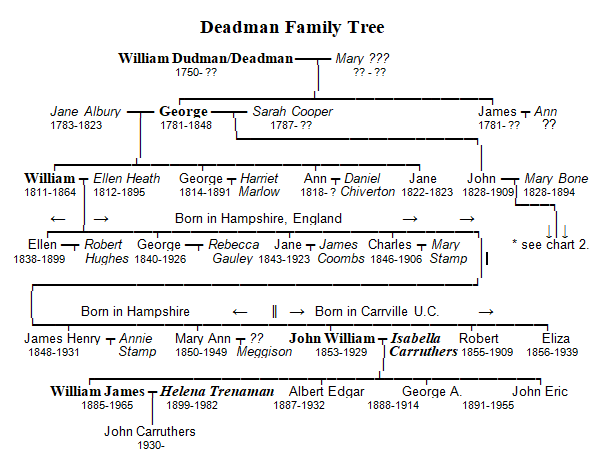
Further, the old parish records show that William Dudman/Deadman was born in Alton, married a woman from Greatham, and settled around Selbourne, a village about half way in between. Other records mention East Worldham which is only a few miles from Alton.2 They are all within a relatively small area in Hampshire about 20 miles east of Winchester. He had twin sons, George and James, both born on the family farm and baptized in East Worldham on the 6th of February, 1781. They were apparently referred to as the Dudman twins in the family.
The older twin, George married Jane Albury in Selbourne on the 31st of July, 1810. They are shown as having four children. Jane Albury died in 1825 and George married Sarah Cooper on 14th of December, 1826. Such second marriages were not uncommon shortly after the death of a spouse. Wives often died in childbirth or of post-puerperal infections and fathers could not run the farm and look after young children by themselves. A fifth son, John was born to George and Sarah on the 9th of March 1828. George died in Selbourne on the 24th of May, 1848.
The younger twin, James was a wheelwright in Lambeth, now part of London. His wife’s name was Ann. Apparently his nephew, also named George, apprenticed with him and then worked in the family business. In his last will and testament, James left his business in Commercial Road, Lambeth to his nephew, and this branch of the Family continued to live in London. Bill Deadman was in touch with one family on his later travels to England, and several other Canadian relatives were in touch with Alan Deadman of Oxford who has done considerable research into this side of the family.
The four children of George and Jane Albury were named William, George, Ann and Jane. William was born in Selbourne, christened on 15th of September 1811 and married Ellen Heath in Greatham on 25th of October, 1836. They had six children born between 1837 and 1849. It is noted that several of the children are shown as christened in East Worldham, a small village a few miles from Selbourne. It is probable that the family lived on a farm somewhere in between. The family emigrated to Upper Canada in 1851 and settled near Carrville, a small village in Vaughn Township west of Yonge Street in what is now the city of Richmond Hill. They had three more children. The oldest was John William Deadman, the father of Bill who was born at Carrville in 1853.
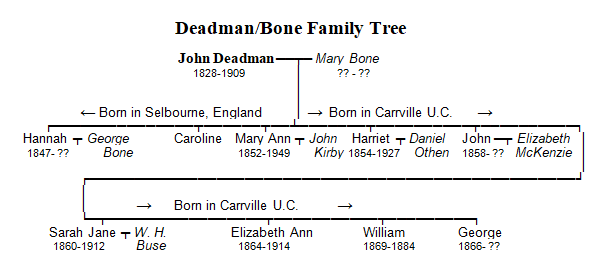
The fifth son, John, from George’s marriage to Sarah Cooper was born in 1828. He married Mary Bone on the 5th of December, 1846 and within a year after his half-brother William had come to Upper Canada, they also emigrated and lived in the same area near Carrville. They had nine children, six girls and three boys. Four were born in England and five in Carrville. In the mid-19th century, Carrville was a heavily settled farming community in the Home District of Upper Canada.
The name of the settlement no longer appears on the maps, but the Methodist cemetery is still there, and a cluster of Deadman grave markers from that period. William Deadman died in Carrville on the 21st of May, 1864 but his wife, Ellen Heath lived until 7th May, 1895 when she would have been 83 – a great age for those days.
John, the son of George’s second marriage to Sarah Cooper married Mary Bone in Hampshire on the 5th of December, 1846. This family emigrated to Upper Canada and also settled in the Carrville area sometime around 1852. The Upper Canada census of 1851 (which was mostly done late in 1852) shows William Deadman, Ellen and six children ranging in age from 15 to 3. It does not show his half-brother John and Mary so they must have come to the area too late to be counted. John died in 1909 at Carrville but Mary lived until 1920. Interestingly, in the 1881 census, Mary is shown as living in Tecumseth Township with other family members, but John’s name is not shown. His whereabouts at that time are not clear.
Bill’s father, John William Deadman, was the seventh of nine children born at Carrville in 1853. He was the first one born in Canada – his older siblings were born in England. When he was old enough to strike out on his own, he realized he would never inherit the family farm, and all the good farmland had been taken up around Carrville. So he went to Tecumseth Township, in Simcoe County, near the village of Beeton. In the 1881 census he is shown as living with his aunt, Mary (Bone). He worked as a farm labourer until he was able to buy his own land in 1891. He married Isabella Carruthers in Alliston on the 24th of March, 1884. The witnesses are both young women from Alliston, one of them has the same last name as the presiding clergyman, suggesting that she may have been wife or daughter of the clergy. Presumably the other was recruited locally. It is not known why neither John or Isabella brought family members as witnesses.
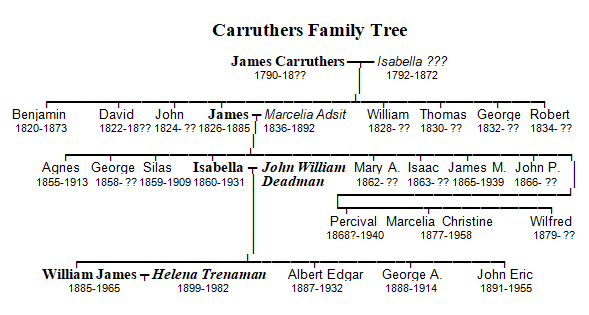
Isabella Carruthers (known as ‘Bel), was born on the 25th of November 1860, the fourth of nine children of a well-established family in Beeton who had come from Dumfriesshire, Scotland at about the same time as the Deadmans had come from Hampshire. Her father James Carruthers, was born in 1826. Her mother Marcelia Adsit, was born in 1836. It was noted that James’s father was also James Carruthers, born in Dumfriesshire in the 1790s and his mother, Isabella, was from the parish of Applegarth, an area just north of Lockerbie that no longer appears on the maps. The small village of Carrutherstown is about 10 km. south of Lockerbie, so clearly Carruthers was a popular name in that part of Scotland. It is part of the Clan of Bruce.
Her father James was the fourth of eight sons born between 1820 and 1834. He and his older brother Benjamin immigrated to Simcoe County in 1852 and brother David came about a year later. James married Marcelia Adsit shortly after his arrival in Canada and they settled in Beeton. The family of Benjamin Carruthers settled in the Beeton area. They intermarried with the Heuchans and the Palmers and many of the first names were used in both families. There is more than one Agnes and Isabella Carruthers in the Beeton Cemetery. Other brothers came over the next few years and settled in Essa, Adjala and Tosorontio townships adjacent to Tecumseth.
Living conditions in Scotland at that time were desperate for common people. The so-called Highland Clearances had started in the mid-18th century but were still continuing. They devastated the tradition-based semi-feudal crofters’ landscape even in the Lowlands to the south and the misery was compounded by a severe potato famine in both Scotland and Ireland in the mid-19th century. Emigration was in full swing both to the British colonies, especially Canada and to the United States. This family of Carruthers was only one of many who crowded the ships on the long difficult passage across the Atlantic.
There were eleven children to James and Marcelia born between 1855 and 1879.3 Agnes was the oldest, born in 1855 married Worsley and died in Kearney in 1913. George was next, born in 1858; he is shown in the 1891 census as having a wife Mary and three young children. Silas was born in 1859 and died in Beeton in 1909. In the 1891 census he is living in Beeton with his younger siblings James M., John P., Christine and Wilfred.4 Isabella, (Bel), was born on November 25th 1860, married John William Deadman on March 24th 1884 and died in Hamilton at her son Bill’s home on the 5th of August, 1931 and was buried in the family plot in Beeton. Bel appears to have been the mainstay of the family for many years. When others were ill or in difficulties, Bel would take them in or provide succour. Mary was born in 1862 or 1863 but little else is known of her. The census also shows Mary A. Adsit, age 63. This was Marcelia’s mother who apparently was living with them at that time.
James M. was the third generation to be named James. He was born in Beeton in 1865, married Laura McIntosh and struck out for New York as a young adult and carved out a successful business career. This is the brother that helped Christine get a job in New York. He continued to maintain close contact with the family throughout his life and died in Ocean Grove New Jersey in 1939. After him came John P. born in 1866, Percival a year or so later and then Marcelia Christine, known in the family as ’Teen.
Christine was the one with the closest association with the Deadmans. She must have been something of a ‘menopause baby’. She was born on 20th September, 1877 when her mother was about 41. She was about 17 years younger than Bel, and only 7½ years older than Will, her nephew. Christine seems to have been a bit of a rebel. Her career and her life probably shocked the staid communities of Tecumseth Township. When she completed primary schooling in Beeton, she went off to New York to live with her older brother, James some 12 years her senior and took training as a “typewriter”.5 In the period before the Great War, she was living on her own in New York, and had a senior stenographic position with the Prudential Life Insurance Company. She never married, and because people back in Beeton must have viewed her lifestyle with some scepticism, she said very little of it on her infrequent visits home. The story then became a bit confused.
Apparently, she became ill and when she returned to Beeton, sometime in the 1920s, she was going deaf and was very depressed. Christine was nursed at home for a while by her sister Bel, and after a long time she seemed to recover, but she was stone deaf. Many people speculated that she had an unfortunate love affair and had gone deaf to shut it out. William always thought that she had a form of nerve deafness, and this had caused her depression. In retrospect, it is possible that she could have gone deaf with an infection related to the great Spanish influenza epidemic of 1918-20, or developed otosclerosis or a 6th nerve degeneration at the height of what sounded like a very successful career in New York. This would mean that she could not work, or for that matter, carry on any part of her lifestyle. It is easy to understand why she might become depressed.
In those days it was socially acceptable to talk about deafness, but not depression. People used euphemisms such as died of a broken heart even to cover situations where the person had committed suicide. Another one was used to describe Elizabeth Barrett Browning. “She took to her bed, and did not get up for years. She became a recluse.” That did not happen to Christine. After the family home in Beeton was sold in 1933, she lived with William’s family until her death in 1958. Despite her deafness, she was very much involved in life right up to the time of her admission to a nursing home a couple of years before her death in April of 1958. She was 81 at that time.
William Deadman was born on January 11th, 1885 at the village of Beeton, Tecumseth Township, Simcoe County in the Province of Ontario, Dominion of Canada. He was the first child of Isabella Carruthers and John William Deadman, who had been married only nine months before. The name William came from his grandfather and it was also his father’s second name. James came from his mother’s father and was a common name on both sides of the family. When William obtained a new birth certificate as an older adult, he discovered that he was born in 1885, not 1886, as he had always believed.6 He further discovered to his surprise that he had been baptised William James Levinas Deadman. Apparently his father never liked the third name and it was never used in the family. His mother called him Willie, his father called him Will as did most of the rest of the family. In adult life, everyone knew him as Bill.
His son7 recalls as a child asking his father where the name Deadman came from. The son was being kidded and teased about it in public school. His father said that he had had the same experience as a child but as he got older and people got to know him better, the name was no longer a problem. He instilled in his son a sense of pride in family and origins, no matter how humble or strange they may be. He suggested that if one cannot feel good about oneself and be proud of family background, one cannot feel good about anything in life. He added that as a child, he had always determined that when he became an adult at 21, he would change his name. But when he became 21, it didn’t seem to matter anymore so he never did it. William said that two of his paternal uncles had simply dropped the ‘a’ to change the name to Dedman.8 Will had grown up with his first cousin, Milton Dedman who lived in Bradford, Ontario. Both father and son agreed that if they were to change the name, they would make a complete change. But it never happened.
In 1886, another son Albert Edgar was born, and in 1887, George A. The youngest, John Eric, was born in 1891. In 1891, when Will was 6, his father bought the south half of lot 10, Concession 109 from William Banting10 of Alliston, a village just a few miles to the north.11 Much of the land had not been cleared, so the first few years were very hard, building a barn and house,12 draining part of the cedar swamp near the creek, and getting a few crops in the ground. Their farmhouse was built later. It was of concrete blocks with a moulded stone-like pattern facing out – a more substantial house than the white clapboard houses that were common in that period. As these communities became better established, many houses were of brick but this was more expensive. 13
In lieu of taxes, local settlers were expected to maintain the concession roads which abutted their property. Because John William had a corner lot, on the 10th line and 10th road, he built a bridge of logs over the creek where it crossed the road allowance. The modern bridge of poured concrete – the latest replacement – has a plaque on it stating that this is “The Deadman Bridge”.
Although the Deadmans were Methodist, Will’s mother raised the children as Presbyterian as the Church of Scotland in Canada was called. In a later census, they are shown as Church of England. They lived about 4 miles north of the nearest church in the village of Beeton so in the early years they didn’t get to church very often. Will recalled his mother teaching them about the Bible but did not remember attending church except on special occasions.14
Will’s younger brother George was the farmer, and even as a boy, showed the most interest in the farm. Will was much more likely to be reading a book, or fixing something in the barn. Albert was also interested in the farm and helped his brother with the chores and work in the fields. As he grew older, he was more sickly and could not work as hard. It was discovered when he was in his 20s, that he had “consumption” as tuberculosis was then known. He later spent time in the Hamilton Mountain Sanatorium where he died in 1932 aged of 43.
This was tuberculosis. In the 19th century, before the Tubercle Bacillus had been discovered, it was a scourge like cancer, venereal disease or mental illness – not to be talked about in polite society. There was no cure, and everyone who contracted it would eventually die of it.15 It seemed to run in families so the infectious and contagious aspects were not fully understood at that time. The tubercle bacillus (mycobacterium tuberculosis) had only just been identified by Robert Koch in Germany in 1882, and many strange notions of the disease persisted until well into the 20th century. Certainly a farm family at the turn of the century would have been quite unaware of all these things.
John Eric was shorter in stature, and remained “the baby” of the family for many years. His mother doted on him, but his father never thought that he would be able to take over the farm. When Will was in medical school he recognized that Eric probably had suffered a birth injury,16 and this explained why he had not developed as well as the others. This degree of illness history was not at all unusual in those years. In fact, according to contemporary records, the family’s health would be considerably better than many of their acquaintances and of other pioneer families.
John and Isabella had 4 boys – a pioneer farmer’s dream. Unfortunately this dream was not to materialize. Will, the oldest had no interest in farming and sought a career first in teaching, then in medicine. George, who had a keen interest in farming, was killed in a barn-raising in his 20s. Albert (Bert) developed tuberculosis and was in and out of the Hamilton Sanatorium most of the rest of his life. And John Eric (Eric), the youngest, had a birth injury that restricted his development and ability to work on the farm.
Life on the Farm
Will never talked about his childhood much. It is almost never mentioned in his own memoirs. When he did refer to it, he described it as difficult and unpleasant. In the early days on the farm, one could not afford to be sick. There was hard work, hard work and then more hard work. By the time Will was of school age, in the 1890s, a farm depression gripped the land, and the prices for agricultural goods were very low. His father was a good farmer, so they always had enough to eat, but never anything else. Will recalled a family down the road, where there was always a lot of sickness. He said that malnutrition, poor hygiene, and poor family life probably was the reason that none of the seven children lived to be 25. His brother Albert was a close friend of one of the boys in that family. Will was convinced that that was where Bert caught the tuberculosis that eventually caused his death in 1932.
Will remembered all the work, which he undertook from an early age. Settlers in those days would have very little cash, and would be absolutely dependent on the food they could raise to survive. Only if they had a surplus, could they sell some to get money. They made everything they needed from materials at hand, and repaired and reused everything. William recalled when he was too young to work in the fields, his job would be to straighten nails and oil rusted hinges which he would painstakingly remove from an old broken gate, so that they could be used again.
In his later writings, Will told about early days on the farm. He recalls that the existing townships were filling with settlers and new counties (Dufferin, Grey, Bruce) were created on Crown land in what became known as the Queen’s Bush. Will became more eloquent and nostalgic. He describes this period.
“I was born toward the end of the nineteenth century in Beeton in Simcoe County Ontario. I remember Queen Victoria’s Diamond Jubilee and was in High School during the Boer War. Like most Canadians I thrilled to the ringing verses of Kipling, that poet of Empire, for in those days, we were rather proud of our Empire, upon which “the sun never sets.” Colonialism then was not the “naughty” word it seems to have become today.” 17
In “Memoirs of a Pathologist” he says:
“I had my childhood and part of my adolescent period in the so-called “gay nineties”, toward the end of the Victorian Era, and indeed, of the Pax Britannica. Whatever may have been the faults of the Victorian era, its virtues were real, and its philosophy of life and of living based on the age old sound principles of human conduct, principles which seem at times to be flouted by the present generation. Memory takes me back to the good Queen’s Diamond Jubilee, to Kipling’s soul-stirring imperialism, tempered by his solemn warnings in the recessional.”
He goes on:
“When I was six years of age, my father bought a farm two miles north of the village from William Banting, father of the late Sir Frederick, a few years before Sir Frederick was born. In later years, and after he has become illustrious through the discovery of insulin, we became close friends, and I spent many interesting hours on visits to him in the Banting Institute for Medical Research, so named in his honour. His tragic death, while on active service in World War II was a great loss to Canadian Medicine, and to his Canada, his Commonwealth and Empire.”18
It is noteworthy that some famous Canadians came from this same area. Sir William Osler and Sir William Mulock from Bond Head, Sir. Frederick Banting was from Barley Creek in that area near Alliston. Kate Aitken, a CBC Radio personality from the 1950s and ’60s went to Beeton Public School, but as she was quick to remind Will whenever he mentioned it, “…some years later.”
The Late 19th Century – Social and Economic Visions.
The closing years of the Victorian age saw many changes of government and several political issues that were to plague the new dominion well into the 20th century. Reciprocity was advanced by the Liberals and strongly resisted by the Conservatives. The Boer War also caused divisions between French and English. But it was the Manitoba Schools issue that was the most serious.
Canada could most charitably be described at 1890 as stagnant. Despite keeping the West out of the hands of the Americans and despite the railway – a financially unlikely project for such a small, poor country – the needed immigrants had not come. To the contrary, over the previous twenty years, there had been a total net loss of 300,000 people through emigration, that is, many came to Canada, but many more left, mostly to settle in the United States. Overall population increased due to natural causes, but large areas of the country were empty or nearly so, and not only in the West as is usually pointed out in History text books. In 1890, the McKinley tariff shut a barrier down across Canadian grain exports to the U.S., and the Americans refused to negotiate any kind of trade deal with the Dominion. Manufacturing was growing due to the National Policy, but this was still a rural country whose wealth depended on agriculture.
Two stark proposals appeared in this era for Canada’s future. On the one hand, the Liberal Party advanced the need for full open borders with the U.S. – reciprocity it was called then – and a continental outlook for Canada as a source of raw materials for the republic to the south. One extreme thinker, Goldwin Smith, an Oxford Don translated to Canada, advocated union with the United States as the only sensible policy, and as the inevitable future in any case. The other proposal, championed by the Conservative Party, was of a ‘British’ nation to the north, trading with both the old world and the new, but with tariff and incentive policies aiming to create a transcontinental nation. This was the philosophy which was to catch the imagination and intellect of a young William Deadman and was to guide his attitude towards his country to the end of his days. He was not alone in this attitude. Many Canadians in this era were eager imperialists, seeing a bright and prosperous, and even powerful future for Canada within and eventually at the head of, the British Empire.
In 1891, people voted Conservative this time around because they saw the very real danger of annexation. Half of Canada’s revenues came from tariffs and customs duties (there was no income tax yet), which would be lost. Closer ties with the U.S., even if short of full annexation would mean erecting trade barriers against the ‘old country’ which provided almost as much financing, not to mention our entire defence and foreign policy. People still had also a loyalty to the mother country, as well as a nascent loyalty to the new country, Canada.
By 1896, the Conservatives were divided, especially over issues of race and language; the Manitoba Schools Question being the most divisive. In1869 after the first Riel rebellion, Louis Riel set up a provisional government in the Red River Colony that prompted negotiations with the federal government to resolve its legal status in Canada. Manitoba became a province under the Manitoba Act19 in 1870. The government sent in the militia to restore order. This provoked the second Riel rebellion20 that led to Riel’s hanging for high treason. At that time the population was largely francophone, and Roman Catholic, with relatively few Anglophone Protestants from Ontario. The settlement provided for denominational schools based on religion. The Roman Catholic, mainly francophone Métis, population were predominant and the Protestant Anglophone population were very much in the minority. This meant that the schools issue was both religion and language – a potentially toxic mix.
When Manitoba entered Confederation in 1870, French Catholic and English Protestant schools were accorded equality as the two groups were roughly equal in numbers. In the 1890s, the now majority Protestant English caused this deal to be abrogated. The problem of ‘English and French’ was to exist as the fly in Canada’s ointment to the present. Unusually for his time and place, Protestant William James Deadman spoke some French. He also loved Quebec and the French Canadian people and visited it at every opportunity. His criticism of them for not joining willingly into the Boer War and the two World Wars was said more in sadness than in distain.
In foreign affairs, Canada was entering a dangerous period, one where the interests of Britain in its relations with the U.S. did not always match those of Canada, with Canada being the loser. This was to be the genesis of the long drive for full autonomy for British North America, or at least that part called the Dominion of Canada. Thus Canada, still connected to Britain, might find itself drawn into the increasingly tense situation in Europe, and might (and did) find itself harmed by Great Britain’s new policy of appeasing the Americans in the Americas. The British saw their alliance with the Americans as being necessary to strengthen the Empire’s world-wide position, should a European war come. The dominions had to think of the empire as a whole, if they wished to play a leading role in it.
This was an odd and ironic time for Canada culturally. There was indeed a growing desire for more independence for Canada, but a curious kind of independence which eventually would be seen as unworkable. It is one which with the imagination can still play: a fully independent nation within an empire, a country with its own constitution,21 its own foreign policy and representatives, but which was intimately tied culturally and diplomatically, though less so commercially, with the imperial centre in London. This was the golden age of imperial popularity in English-speaking Canada. In French Canada, the concern was merely to hold onto their still religious culture within their borders in Quebec, and to support the declining French speaking communities outside Quebec, while allowing the English to play in the imperial playground, largely, but not entirely unsupervised. For Canada, this was not a pipe dream, although the emotional connection was very strong, but also a sensible, perhaps the most sensible policy for that age.
Fin de Siècle – The Apogee of the Victorian Age.
1897 saw the imperial conference of the senior dominions and Great Britain, held in the same summer as Queen Victoria’s Diamond Jubilee celebrations. This amazing display of imperial might could be said to mark the apogee of the Empire. Discussions were held over the creation of an imperial parliament, or at least an imperial council, for example, but alas nothing was to come of it. This might have marked the beginning of a truly effective united nations, centred on the old structure of the British Empire. Although it did mark the beginning of regular imperial and then commonwealth conferences, the ideal of a functioning imperial system in the modern world was not to be. The test for Canada and for the Empire was to be the South African (or Boer) War a few years later.
Public School Days.
In September, 1891 Will began attending school. He walked about 2 miles each way from his home. A whole new chapter in his life was opening up. His early life began when Canada was still mired in depression, but as he grew older, the land gradually became more prosperous. By the time he entered the University of Toronto in 1907 ‘boom’ times were here. These good times lasted until 1913, when another world economic collapse began.
In September, 1891 Will, age 6½, started attending School Section No. 19, Tecumseth Township, the rural school at Beeton Junction, on the 11th concession, 10th line, about 2 miles from his home. Beeton Junction, originally known as Allimil, was the place where the Hamilton & North-Western Railway line divided, one branch going to Allandale near Barrie, the other to Alliston and Collingwood. This was a typical school of the day, with about 30 pupils in all forms. The teacher, usually a young man who had taken a 6 month course in Model School was king of the roost and discipline, usually a leather strap to the hand, was meted out freely. Will’s first educational experience was in a one room rural school. A decade later in his career, he was destined to teach in them.
Small rural schools were dotted all across the province. In those days, the rural townships were divided into “school sections” and there were small one-room school houses to serve each section, usually located at major intersections of concession roads. In theory, these schools were within walking distance of every farm, but this was seldom the case in practice; some children would have to walk several miles, winter or summer, rain or shine. In extreme cases, if the parents could not get the children to school, they simply did not attend. If the local school section could not obtain a teacher, the children might have to walk to the next nearest school, or simply stay home. In cold winter weather in some families, there may not be enough heavy winter clothing for all the school age children, so the oldest would go and bring home work for the younger ones to do. At spring planting and harvest time, boys old enough to help in the fields were seldom at school and this was considered normal. Although the school year ran from the beginning of September until the end of June, attendance after late May and before mid-October could be quite uncertain.
The primary schools, usually referred to as “public school” had 4 forms but because there was a ‘junior’ and ‘senior’ year in each, it represented 8 years of schooling for the average pupil. But it was quite common for good students to do a whole form in one year. These were not changed to the present system of 8 grades until 1937 in most parts of Ontario. The secondary school, commonly called “high school” also had 4 forms but there was only one year in each. This represented a total of 12 years of public education.22
Tecumseth Township and Beeton.
In the 1890s, Beeton was a busy and prosperous place. As a child Will recalled several notable citizens who were still living there. D.A. Jones, the ‘Bee King’, W.J. Bell, R. Scott, the Pringles. He remembered going to Sunday school at the Presbyterian Church. He remembered the Queens Hotel and the Commercial Hotel on the main street and the Station Hotel near the Grand Trunk line on the edge of town. He remembered Beeton Junction about four miles north of the town where the branch
line to Alliston split off. That was also the location of S.S. No. 19, the one room public school he attended for six years.23
He remembered the Banting Farm which his father had purchased when he was six. Bailey Creek ran through it and his father built the log bridge that crossed it on the 10th line, which the locals always knew as the Deadman Bridge. The railway owned a 6 acre strip across it and Will had many recollections of the trains that determined the farming day. He recalled working on the farm, fishing in the creek and the cedar swamp, Sunday school picnics and Christmas Concerts. He recalled passing the Entrance in 1897, the year of Queen Victoria’s Diamond Jubilee. The town was decorated in red white and blue on both the Queen’s official birthday, May 24th, and on July 1st, Dominion Day. The town band would play in the band-shell and everyone turned out in their Sunday best. It was a time of excitement and optimism. The new Dominion was thirty years old.
He remembered Bond Head, on the eastern boundary of Tecumseth. It was noteworthy in another way, as he recounts in his writings:
“Bond Head, so named after a Governor of Upper Canada, was the birthplace of two famous Canadians. Sir William Osler, who in 1889 became the first Professor of Medicine at John’s Hopkins Medical School in Baltimore, and who was later Regius Professor of Medicine at Oxford University was born here. Sir William Mulock, who was Canada’s well-known Postmaster General… in the government of Sir Wilfred Laurier…i in the early years of this century, and who was responsible for Imperial Penny Postage, was also a native. He was Chancellor of the University of Toronto for more than twenty-five years. In 1936, the University Alumni Federation, of which I was President, honoured him at a banquet at the Royal York Hotel attended by some 700 graduates, at which the Postmaster General of Great Britain conveyed to him his congratulations by transatlantic radio. ii
Will recalled many happy times – spelling matches, Christmas concerts. He speaks of summer holidays, exploring “the swamp”, fishing and swimming in the creek with his brothers. He completed the four primary forms at S.S. No. 19 in six years, getting his ‘Entrance’ in 1897 when he was 12½. He discovered that he loved school. As he was the oldest, he often had to coach his younger brothers if they were unable to go, or if his father required them to work on the farm. He was sometimes held back by his father, who regarded the fourth form (eighth grade) as a good education but his mother would plead on his behalf, because if he missed too much school, the younger boys also could not keep up. But Will wanted to go on to high school and his mother supported him.
Will had done well in the public school in Alimil – completing 4 forms in 6 years. Again he faced a difficult choice. His father considered this to be a good education and he was needed to work on the farm. But this was a life that he hated and he had set his heart on getting a better education. His family had several members that had gone on to professional careers. Two of his uncles had done so. James Henry was a professional engineer, living in Bradford. His maternal uncle, James had moved to New York City and was well established in business there. His maternal aunt, Marcelia Christine had moved to New York after completing school in Beeton and her brother had helped her get a secretarial job with the Prudential Life Insurance company which she held for many years.
As we have discussed, this was a period of restless movement in the new
Dominion. Immigrants were arriving, mainly from the old country but they often did not become permanent residents. Many used Canada as a stepping stone to a better life in the United States. In that period, net immigration was often exceeded by net emigration resulting in very slow increases in population based on natural increase alone. Will’s father was born a farmer and he was a good one so all he could see was maintaining the family farm and passing it on to the next generation. But the children were seeing the new world opening up and they had different ideas.24
Throughout this time, Will got support from his mother. She could also see the new world opening up. She could also see how Will was unhappy on the farm and was always exploring everything around him. His observations of the health of the families around him only whetted his appetite to learn more about health and disease. He also had been encouraged by his teachers who realized that he was very bright and would not be happy stuck on the farm. His father finally had to give way. Will enrolled in the Beeton Continuation School that offered the first two forms of high school. He was on his way.
Beeton Continuation School.
Beeton did not have enough students to justify a full secondary school, so the Beeton Public School added first form and later second form of high school and called it the Beeton Continuation School. In September 1897, he started at that school. He mentioned several classmates, Frank and Earl Scott whom he referred to as the Scott Boys, Henry Aiken, Kate Scott, Martha Law. He also talked about walking into Beeton every day, a distance of over two miles. He became more involved in the social life of the village. He passed the Public School Leaving Examination in Beeton and the certificate is dated October 25th, 1898. 25 He describes it this way:
“After passing the Entrance examination I began my secondary school education at the Beeton Continuation School which provided the first two years of the course for Junior Matriculation to the university. The principal at that time was a Mr. Joseph McPherson, and, though he was in his forties, the older students referred to him as “Old Joe”, not, of course, in his hearing. The leading general store of the village was operated by Mr. and Mrs. Robert Scott, and several members of the Scott family were in school at the time. Frank Scott, later a prominent Toronto surgeon was a classmate of mine. His sister Kate, afterward Mrs. Aitken,26 attended this school, but she was careful to add, if I mentioned this fact in conversation, ‘but not at the same time’…”iii
In 1899, the Boer War began. Troops were being sent off to South Africa and Canada, with the other dominions was making a contribution to the war effort. The long years of farm depression – from the early 1870s to the late 1890s with some improvement during the 1880s – had finally lifted, the price of wheat increased to a dollar a bushel27 and farming was good. As in 1914 and in 1939, it seemed to take a war to get the economy back on track. In writing he said:
“I recall the depression of the so called “gay nineties”, when wheat was 50 cents a bushel; and the threat and onset of the Boer War where the price of wheat went to over $1.00 a bushel. I recall my days at High School, which were concurrent with the course of the South African War, the relief of Ladysmith, the death of Queen Victoria and the accession of King Edward the Seventh to the throne. I remember well the “cold war” of the early part of the twentieth Century created by a truculent Germany, instead of a truculent Russia. I recall vividly my four years of teaching public school, in North Grey, and my entry into the University of Toronto as a freshman in 1907.”28
He said that he got out of writing June exams, because his marks during the year were good, and often did not return to school in the fall until late September or early October, so that he could work with his father on the farm. By the spring of 1899 Will had two years of the four required to finish high school and he wanted to complete it but he then ran into a problem. His father felt he now had a good education and should come and work on the farm. After some difficult discussions with his father, he talked to his mother who supported him and then helped him persuade his father to let him complete high school. He would have to go to a larger centre that had a high school with all four forms. The closest and most convenient place to Beeton was Bradford, on the Holland River near the Holland Marsh. Because there were relatives in Bradford who could sponsor him, he decided to go there.
Bradford High School.
Will’s Uncle, James Henry, was his father’s next older brother, born in 1848. He was married to Annie Stamp whose sister, Mary Jane, was married to the next older brother, Charles, born in 1846. Their brother, Thomas Stamp was married to Eliza, the youngest sister of the Deadman family. Such close relationships were not uncommon in those days where populations were small and scattered, families large and very close. James and Annie had nine children, but the first four died at an early age. Of the five that reached adulthood, the youngest and only surviving boy, Milton, was the one that Will had the closest relationship with.
Uncle James had decided to formally drop the ‘a’ from his last name, making it ‘Dedman’. The spelling had been inconsistent for some time, even going back to the English ancestors – presumably trying to avoid its inevitable associations with death. But the other siblings, including Will’s father stuck with what they considered to be the proper spelling. Will learned to live with the inevitable jibes and jokes. It was perhaps ironic that he became the foremost forensic pathologist in Canada in his time. But this was many years later. In 1899, Will arranged to live with his uncle Jim in Bradford and was duly enrolled at the Bradford High School. He stayed with the Dedmans for about three years while he finished high school. He became very close to his cousin, Milton who was of similar age. His narrative continues:
“…. My secondary school education was completed at Bradford, a town situated twelve miles to the east of Beeton. There I boarded with an uncle who was engineer at the local flour mill, and went home to the farm on the weekends. My father used to drive me by horse and buggy 29 to the village of Bond Head which was the half-way point. The remainder of the journey was by way of a horse-drawn stage coach.
Because he was shown as part of the family in Bradford, Will’s high school graduation certificate shows his name as William J. Dedman. Bradford was less than 20 miles from Beeton, but it must have seemed quite a distance in those days. Stage coaches and horse-drawn vehicles could usually only manage about 4 or 5 miles an hour, and much less if the roads were in poor condition as they often were. This means that it was about a five hour trip but despite this, he managed to get home most weekends during the school year.
His uncle Jim was trained as an engineer, which probably gave Will another perspective on professional careers. When he was home, he had talked to his mother’s younger brother about James. Uncle Jim had been born in 1865, had attended school in Beeton and then struck out to New York City to establish his career. This was another influence on Will who was beginning to realize how big the world was out there and the range of possibilities for someone who was not content to stay on the farm.
His mother’s youngest sister, Christine was by this time living and working in New York with her older brother, James. Later, in one of his summer holidays, Uncle Jim helped Will to get a summer job in New York which broadened his horizons further. At that time, backwoods Canada was increasingly regarded as very insular and many people were looking to the States for careers and a better life. Those who did not have the courage or desire to venture forth developed a peculiar but understandable trait of putting down the United States and saying that they had no desire to go there. My father loved the American experience and referred to these attitudes as “Sour grapes”, an expression that was in common use in those days.30
Other notes indicate that this was a broadening experience for him. He began to see his life opening up. It is not clear what he saw as his future when he was on the farm and in Beeton. He had mentioned some aspirations to become a school teacher but he also had seen his fate as taking over the family farm with the help of his brothers. It was probably in Bradford that he really began to imagine a future beyond the confines of Tecumseth Township. He made reference to thinking in French and dreaming in French, a reference to his learning of a second language at the school. One of his teachers at Bradford, a Mr. Foncar, suggested high school teaching. He remembered Mr. Rogers saying to him “…stay yourself.” But he was still trying to find out who yourself was.
His Bradford days were happy ones. He recalls playing baseball in the schoolyard and his first introduction to English Football.31 He also recalls lacrosse and field hockey. Ice hockey was popular in the winter time but not all students had hockey sticks and skates. He says little of his social life, but as he had mentioned sometimes later, opportunities for people of the opposite sex were very limited and strictly chaperoned so he said that in those days he felt increasingly awkward with girls and at adolescent social events.
According to the dates so far, he should have completed his Matriculation (Part II Leaving Certificate) in 1901 at the age of 16½ but this did not happen and his accounts of this time seem quite vague. When he reminisced with his son John, (the lead author) he talked about his childhood but always seemed to gloss over this bit. His son always assumed that he had taken 8 years in primary school and 4 years in secondary school, getting his matriculation in 1903. He had taken a short course at Model School and to make it fit, this must have taken place in the summer months and then he began school teaching in the fall of 1903. In Hamilton Memories he describes it this way:
“I completed my matriculation at the Bradford High School, and, after a four months course in teaching at the local Model School there secured a Third Class Teacher’s Certificate. …”iv
However, his school certificates clearly show that he finished primary school in 6 years and spent 2 years at the Beeton Continuation School. So he must have gone to Bradford in 1899. He should then have gained his matriculation in another two years in 1901. If he then went to Model School for half a year, this still leaves a year and a half unaccounted for. The answer to this dilemma is in one of the pencilled outlines which he wrote only in point form and never expanded into text:v
“Uncle Jim – Milton – Stage to Bradford – the farm – summer holidays – Baseball –
Senior Matric – failure
Bradford Model School – Mr. Scarrow – search for a school”vi
This fits much better with the known facts. His Graduation diploma is dated 22nd day of November, 1901 but it is also called “Junior Leaving” which does not suggest that he had completed his senior matriculation in 1901. Evidently Will failed his matriculation on his first try in 1901 and had to repeat it in 1901-02. This also explains his great concern when his sonvii failed an Upper School Latin Authors examination many years later. Instead of being annoyed, as his son expected, Will was very understanding and took on the task of appealing the failure to the Department of Education. The appeal was successful, largely because his son had high marks in other subjects but Bill felt it was a personal triumph – which of course it was.
So after he completed 4th form in the fall of 1901 he then must face where he was to go next. The choice was between high school teaching and another professional career such as medicine. He decided to start with teaching and science because he could use that experience whichever way he went. Again, his mother came out on his side and persuaded his father that he should pursue a professional career. Father was finally beginning to take pride in his son’s accomplishments so he agreed although he would not have enough money to give much economic support. Will had to go to work to earn enough money to go farther.
1 Since William and James were very common names in the Deadman family and William James Deadman was known as Bill to his friends throughout his life, we shall henceforth refer to him as Bill to distinguish him from all the other Williams in the family.
2 All of the place names mentioned here are within a few miles of each other. Alton was the home of the author Jane Austen, who lived there mid nineteenth century, although there is no record that the Dudmans/Deadmans and the Austins knew each other.
3 Isaac is mentioned in the 1871 Census. He was 8 years old at that time. The youngest son, Wilfred, is shown in the 1891 census as being 12 years old. However, their names do not appear in any other family records.
4 Silas’s father James died in 1885 and his mother Marcelia died in 1892. his older brothers were married with children and living in the South Simcoe area. His occupation is shown as ‘hotel clerk’. According to family tradition, Silas was living with his mother and the others in Beeton at that time although his mother is not shown in the 1891 census.
5 … as the operators of the new-fangled typing machines were known. They are now called typists and the machine is the typewriter.
- 6Many of the newspapers had his birth as 1886. A death notice in the Hamilton Spectator listed his age as 79 when it was really 80.
- In formal terminology, he will be referred to as Doctor Deadman or as WJD. For the early period he is called Will and the later period of his life he is called Bill.
7 His son is the lead author, JCD. He recalls many incidents that are not otherwise recorded.
8 There was some variability. In the 1871 and 1881 census records, several members of the family show the name as Dedman but in another census, the same name is shown as Deadman.
9 Townships were divided into blocks called “concessions”. A Concession was 1000 Acres, and was usually divided into 10 lots of 100 acres each. However Tecumseth Township had 5 lots of 200 acres each. The original deed of land for the Deadman property described it as “The south half of lot 10, Concession 10…”
10 He was the father of another famous physician, Sir Frederick Banting, who received a Nobel Prize in 1923 for the discovery and purification of insulin.
11 Alliston is on the extreme north-west corner of Tecumseth Twp. on the line that divided it from Essa Twp.
12 It is not clear from existing records what buildings were on the land when John William bought it. His oldest son, Will was 6 when the family moved there so there must have been a house and probably some out-buildings.
13 The house and barn were still standing until about 20 years ago. At that time whole concessions in Tecumseth Township were bought up for commercial potato farming and all buildings and other obstructions were removed. The ground was leveled for large watering and cultivating machines to operate unimpeded. It was a loss of a whole culture of small family farms.
14 It was apparently common practice for the line of descent to be patrilineal but for the mother to determine the religious affiliation of the family. It was certainly true of the Deadmans. They were Methodist when living in Carrville. John William became Presbyterian and the children were raised that way. WJDs younger brother Eric continued to attend the Presbyterian Church even though WJD had become at least nominally Church of England when he got married.
15 Large sanitaria were built all across the country and in the 1930s the Hamilton Mountain Sanitarium at Chedoke had the distinction of being the largest in the British Empire.
16 He had a ‘rupture’ as it was known in those days. He had undescended testicles and a partial scrotal hernia. Such things were common in those days. Despite this, he was very kind, thoughtful and taught Sunday school in Burlington for many years. He could not do all the more complex functions of a 100 acre farm, yet he managed his brother William’s small 2½ acre plot in Aldershot quite well. He developed a total bowel obstruction probably caused by abdominal adhesions from the earlier hernia and died in 1955 at the age of 64.
17 From ‘Hamilton Memories’. The original version of this textwas a separate document tucked into the file containing drafts of the biography. It could have been the text of a speech. It was probably written between 1960 and 1963 although other similar drafts are much earlier.
18 From ‘Hamilton Memories’ ibid.
19 Passed by parliament and receiving royal assent on May 12th, 1870.
20 Known as the North-West Rebellion.
21 The British North-America Act (1867) was an act of the British Parliament but served as Canada’s Constitution until it was finally repatriated by parallel acts of both the British and Canadian parliaments in 1982. In 1896, in the usual sense Canada’s constitution, like Britain’s, was unwritten but it was a constitution nonetheless.
22 During most of the mid-late 20th century in Ontario, an extra year was added that was supposed to represent the first year of university level and enable the obtaining of a Bachelor of Arts degree in 3 years. 5th Form (Grade XIII) became the new standard for the Senior Matriculation level and 4th Form (grade XII) became the level for Junior Matriculation. The University of Toronto soon set 5th Form as their admission standard for all undergraduate courses and most other universities eventually followed suit. Ontario was the only province to add a fifth year to the high school program. This reverted to four years in the 1990s.
23 In Bill’s descriptions of his school days, only one note refers to S.S. No. 19 whereas other notes indicated that he attended S.S. No. 9, Tecumseth. However, No. 9 was a considerable distance away at Hammill in lot 5, concession 8. No. 19 was at Beeton Junction, only 2 miles from the farm in the same concession. School sections took in pupils from concessions immediately adjacent to them. No. 9 is too far away and S.S. No. 19 would have to be the one that Will attended.
24 John William kept a log of all expenditures. It shows purchases and sales of farm products that was the only source of income in those days.
25 Will described this as Public School Leaving Part I. There was another step which he described as Junior Matriculation but this term was not clearly defined and it is not clear what it applies to. The way in which he uses the term suggests that he was applying it to the completion of Beeton Continuation School. That would be 2nd Form of secondary school. Presumably this would have been Public School Leaving Part II.
26 Kate Aitken was a well-known radio personality on the Canadian Broadcasting Corporation in the 1940s and ’50s. she was also interested in food and published several family cookbooks.
27 There was a headline in “The Globe” from Toronto announcing the improvement in farm prices. “Wheat is a dollar”. This phrase was repeated in every farming community and became the by-word for the improved conditions on the farm.
28 This was another of the earlier attempts at an autobiography entitled Memoirs of a Pathologist. Handwritten in pencil on the backs of old voters’ lists it is an earlier version of some of the material contained in the other writings. Probably written in the late1950s. Its reference to a “truculent Russia” suggests that it was written during the Cold War.
29 In another note he refers to this as a Democrat. This was a popular buggy in this period.
30 It comes from Aesop’s Fable about the fox and the grapes.
31 English Football became known as soccer in the United States and by the turn of the 20th century, that usage spread to Canada. It is still known as football everywhere else in the world.
English Rugby was also called ‘rugby’ in Canada but the United States had developed a slightly different game which they began to call football. Canadian Rugby, like almost everything else was strongly influenced by the American game of football – both based on English Rugby – and by the middle of the 20th century was being called ‘Rugby-Football’ and then just ‘Football’. It is still different from the American game but over time the differences seem to be diminishing. This is yet another example of Canadians’ deference to everything American – especially in sport.
i The reference to Laurier was omitted in earlier versions of his writings.
ii Hamilton of the Teens and Twenties. Handwritten draft. This was a further attempt to write an autobiography. It is similar to earlier writings but each version contains slightly different details. Probably written between 1960 and 1965.
iii Ibid. “Hamilton of the Teens and Twenties”.
iv Hamilton Memories. This was written earlier than Hamilton of the Teens and Twenties. but contains much of the same material.
v Memories of a Canadian Pathologist. There are two versions. This was the second one which is incomplete. Dates uncertain.
vi Memoirs of a Canadian Pathologist. Outline for a book. Chapter headings and brief notes. Date uncertain.
vii Lead author JCD.